
Challenges of the coffee supply chain in the local market of Isfahan
In the field investigation and continuous communication with the managers of commercial bars and third generation cafes in Isfahan, the biggest operational bottleneck is the lack of uniformity of the delivered batches. Transporting roasted coffee from distant sources in the capital or southern ports usually takes between 3 and 7 days, and the packages are exposed to temperature fluctuations in warehouses or freight cars. As a result, the carbon dioxide gas is unbalanced before entering the cafe grinder, and the daily cupping test of the espresso shot becomes extremely unstable.
In addition, the dry climate structure of Isfahan makes the maintenance of green manure more sensitive than humid areas. In non-specialized workshops, not controlling the humidity and temperature of the raw grain storage causes a rapid decrease in density and the appearance of wooden and cardboard flavors in the final cup. The fundamental solution is to purchase raw grain, roasting and quality control directly in the climate of this city and based on planning weekly orders.
Buying raw grain based on quality variables and sieve test
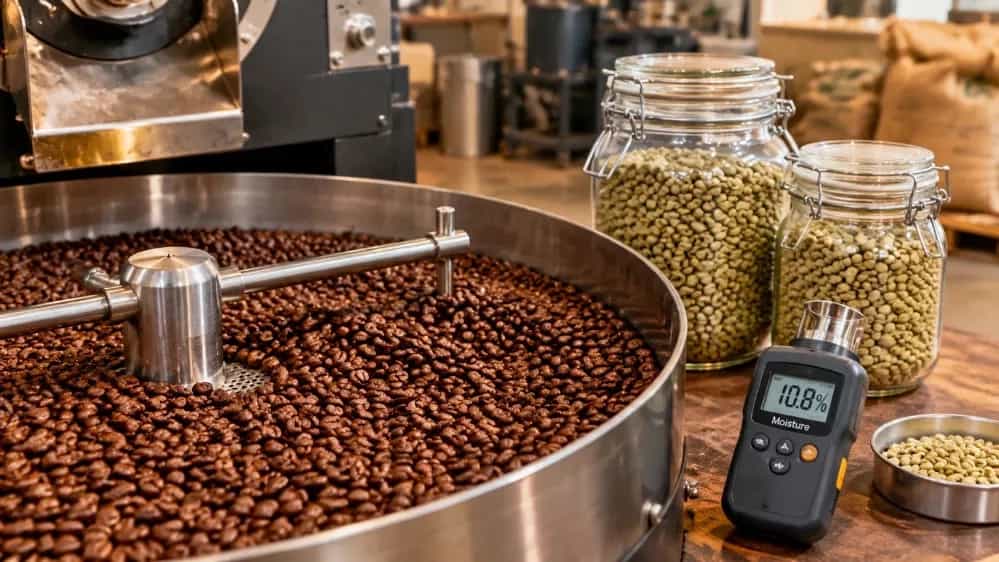
Choosing Dan Sabz for cafe owners and roastery owners no longer relies on mouthwatering brand names, but on laboratory testing. In the technical examination of raw grain shipments, the two primary factors are mass density and internal moisture percentage of grains. The optimum humidity of raw grain should be maintained between 10 and 12%; Seeds with moisture below 9% heat up quickly during the drying stage of the roast, and their outer layer gets local burns before the kernel expands.
Physical separation and sieve testing of defective seeds, such as the initial defects of insect infestation, blackness or rotting, is a mandatory part of green monitoring before entering the roasting cycle. For the base blends used in the commercial espresso menu, specially processed washed or polished robustas from East Asia and Africa, along with controlled acidity South American arabicas, create a sensory balance and stable crema. Accurate knowledge of these types prevents heavy costs in tonnage purchases without returns.
Commercial and specialized coffee roasting standards with a dedicated profile
Roasting operation is not only about darkening the grain, but also controlling the heat transfer of conduction, convection and radiation inside the roasting drum. In Bulky Coffee production lines, roasting of beans is adjusted according to the temperature curve, the rate of temperature increase and the exact development time after the first crack to release the true flavor potential of each bean and eliminate burnt and gray flavors.
The key stages of this process include turning point, yellowing and drying stage, Maillard reaction and caramelization, first crack and finally the final development time or DTR.
Cafes and beverage service groups create a consistent flavor identity for their specialty espresso by defining specific profiles. Maintaining the stability of these profiles in high weekly volumes allows loyal customers to receive the same texture, body, acidity and standard crema every time they visit the cafe.
Formulation of industrial and combined hot and cold menu powders
The cafe menu does not rely on espresso alone; A major share of cafes' cash flow comes from mixed drinks such as hot chocolate, white chocolate, matcha powder, masala tea and foaming mixes. The biggest problem of crowded bars during peak hours is the decrease in the speed of preparation and the change in the taste of the drink due to the imbalance of powdered ingredients.
Using standard formulated powders brings two main advantages:
- Maintaining instant solubility in hot milk or water without leaving gelatinous masses or clots at the bottom of the cup
- Taste stability and precise control of sugar to fat ratio to avoid masking the taste of other spices
In practice, it has been observed that the preparation of non-engineered bulk powders, in addition to increasing the waste of raw materials in the load preparation station, causes clogging of steam nozzle ducts and barista mixer equipment. The uniformity of the particle meshing and the quality of the emulsifier base materials ensure that the serving speed remains high without reducing the quality standards.
Specialized barista training and bar management based on standard methods
Modern equipment and high-quality seeds have no operational value without the presence of a human force that is proficient in the principles of variables. Coffee training courses in Isfahan should go beyond simple learning to work with espresso machine buttons and connect theoretical topics to operational troubleshooting skills.
Mastery of sensory variables and mill calibration
The barista must be able to recognize behavioral fluctuations of the bean during the hours of the day. Factors such as the temperature of the grinding chamber, the air flow in the cafe hall environment and the degree of grain density change due to aging, require the re-adjustment of the grinding degree and change in the weight of incoming and outgoing coffee. By mastering the brewing control table, trainees learn how to keep the extraction efficiency within the standard range without guesswork.
Equipment maintenance skills and boiler depreciation reduction
The water used in Isfahan cafes is a silent killer of the boilers and heat exchangers of the espresso machine due to its high hardness and precipitating salts. Training topics focused on technical skills teach baristas how to perform daily descaling, backwashing with specialized materials, and maintenance of tough filtration cartridges to avoid costly repairs to the business.
An integrated supply chain model to reduce the cost of running a cafe
Insular purchasing of different parts of the bar from scattered vendors increases the cost price of each drink between 15% and 25% due to multiple logistics costs and fluctuations in volume discounts. When a coffee shop orders its choice of raw beans with the right profile, receives compatible tested powders, and trains its personnel to the same behavioral standards of the same beans, it maintains its operating profit margin.